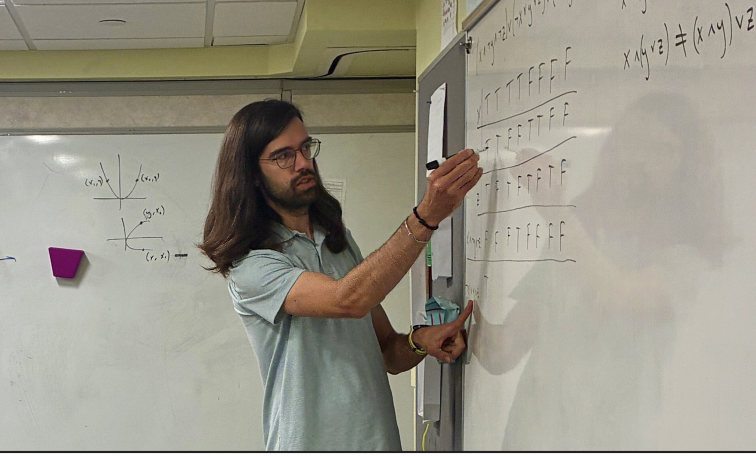
Last year, Upper School (US) History Teacher Matt Turnbull could no longer recognize his own students. Not by their faces, but by their writing.
“I couldn’t tell what was legitimately students’ work and what wasn’t,” he said. “Whether it’s Grammarly or ChatGPT, I don’t trust that a whole group of students is going to not use those things. I would rather give kids three days to work on something than have to do it in class by hand in one period. But we’ve gone past that time.”
This fall, Respondus LockDown Browser — a Canvas add-on that locks a laptop to a single assignment — appeared in classrooms across the US. It was implemented because teachers asked for a test-taking app that blocks the internet to eliminate AI concerns. The technology department also needed to find a solution compatible with students’ personal computers for those with laptop accommodations. So far, the technology department has received mixed feedback from teachers and students.
Currently, teachers have the discretion to decide whether to use the browser in their classrooms. In past years, Mr. Turnbull assigned a multi-night take-home essay to his junior class. This year it was completed online through the LockDown Browser during class.
“When it was a take-home assignment, it was becoming more difficult to tell whose writing I was reading,” he said. “Really, what it’s replaced is some homework that is now in class. I am a big proponent of handwriting, and I would rather do more of that than more LockDown Browser.”

According to Technology Officer Megan Bounit ’97, the department chose LockDown Browser over alternatives like Exam.net because it’s compatible with Canvas, and the department offered it to teachers last spring. No substitute platforms are being considered yet, she said.
“This is a solution. Is it the best solution? It’s not the only solution; we know that,” Ms. Bounit said. “We’re still in the data collection stage and are optimistic that LockDown Browser will meet our needs. But if it does not, then we’ll have to go back to the drawing board.”
The tool was not built for essays that span days, Director of Academic Technology Yumi Nakanishi said.
“LockDown Browser essentially was made for a one-and-done kind of assignment,” Ms. Nakanishi said. “We’re still exploring.”
Students disagree on the effectiveness of the technology. Nathan Ma ’27 uses the browser frequently in his history class. He said he prefers take-home assessments.
“Almost all of my take-home essays have been replaced with online in-class writes with LockDown Browser,” Nathan said. “My best work doesn’t happen in class. I don’t work well around other people.”
Take-home essays teach students crucial time-management skills, he said.
“You can procrastinate all your work until the last day if it’s a three-day essay,” he said. “But you’re kind of taking that away and not giving kids the ability to work on that skill. That’s something that’s really important, especially going to college. Just give it to us on paper.”
Cheating is a student’s own decision that takes away from their education, Nathan said.
“At this rate, what’s the point of having homework at home?” he said. “You can’t punish the good kids because bad kids exist, right? It’s unfair to the kids that aren’t planning on cheating, and at some point, kids need to be trusted.”
Jone Abadie ’28, who uses the browser in her English and physics classes, said she prefers the new browser to paper.
“It’s more efficient, and they can make sure that no one uses AI,” Jone said. “With handwriting, my mind moves faster than my hand, and then I can’t get all my ideas down. At the end of the day, I see it as better than handwriting.”
US English Department Head Ariel Duddy said in-class writing has its benefits and drawbacks in terms of students getting to determine when they do their writing.
“I understand that some students would like to take writing home and decide: My best working time is from 4 to 5 p.m., and now I’m going to work on it,” Ms. Duddy said. “When we use Lockdown Browser in class, we’re not giving that flexibility anymore. Having to complete written work during class time can be hard for students.”
Her ideal is neither all in class nor all at home, she said.
“I think a hybrid model of in-class writing, paired with at-home revision, is the best system,” she said. “I just don’t think we’ve quite figured out how to do so for all writing assessments.”