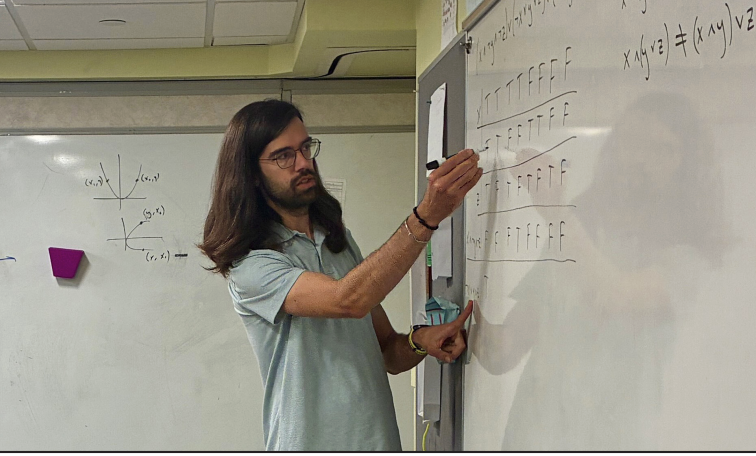
“When students are stuck on a hard problem and have that ‘aha’ moment, that moment of clarity and satisfaction is so fun. For me, that’s what it’s all about,” Upper School (US) Math Teacher and Math Team Coach Joe Cyr said.
Formed in 2009, the US Math Team teaches students new ways to solve problems. Joining the math team requires no competitive experience or specific class level. Students can fill a non-interscholastic sports credit by supplementing the bi-weekly math meetings with two blocks of Health and Fitness each week. Math team can be a creative outlet for students, Dr. Cyr said.
“I think it’s important to give kids who are interested in this sort of thing the opportunity to expand their views a little bit and dig into something that they are interested in in a way that they have never seen before, and won’t see in a math class,” Dr. Cyr said.
The team has inspired students to go beyond the average math class, according to Dr. Cyr.
“People don’t think of math as a creative subject,” he said. “They think of Algebra 2 as more like having set rules, but that’s not really what math is. It is highly creative, by creating your own little abstract world of whatever symbols and symmetries.”
The math team competes every month against other New England schools. Math team members are given problems to answer individually and problems to work through as a group. The school’s score reflects both the individual and team component of the competition.
“We do a good number of competitions,” he said. “We do some different types, but generally speaking, the students get a list of problems, and they have to try to figure them out, which takes a lot of lateral thinking. Some of the competitions we do are team competitions, which I think are a lot more fun, because you get a group of a few kids working together on a bizarre problem and they have to throw out ideas to see what will work.”
Siri Paulsson ’29 joined the math team as a freshman. She said focusing on the broader lens of the problem is more helpful than sticking to formulas.
“Practice is very important, as well as making sure that you have a good understanding of what you are doing,” Siri said. “We talk about the sort of formulas that you do not really need to use in real life. For contests, when you need to solve a problem fast, memorizing formulas helps, but having a good understanding of what’s going on is really important.”
Math team member Maya Figelman ’28 said there’s a lot of preparation in the days leading up to the competition.
“We will look at past competitions and past problems,” she said. “We’ll have 40 minutes and just practice them and go over the answers with Dr. Cyr. Math competitions are definitely different concepts than what you learn in school math and, even though it says all you need is algebra and geometry, there’s a bunch of specific tricks that you have to know for a lot of these problems.”
According to Maya, the math team is a friendly community.
“Sophomore year, it would just be me and Amy, and Dr. Cyr would always have snacks for us, so we would always eat Pirate’s Booty and solve math problems. It was great. Some of the best conversations I’ve had were during math team,” she said.
Nikhil Govindaswamy ’29 joined the math team this year. He said participating in these competitions exposes him to new ways of approaching a math problem.
“The style and nature of problems given at tournaments can vary quite a bit, which makes it important to understand more than one way of approaching a question or applying a concept,” he said.
Team members work collectively to answer problems, Nikhil said.
“From previous experiences on math teams, I’ve learned that it is important to have a strong team culture that is open to several ideas and approaches regarding problem solving.”