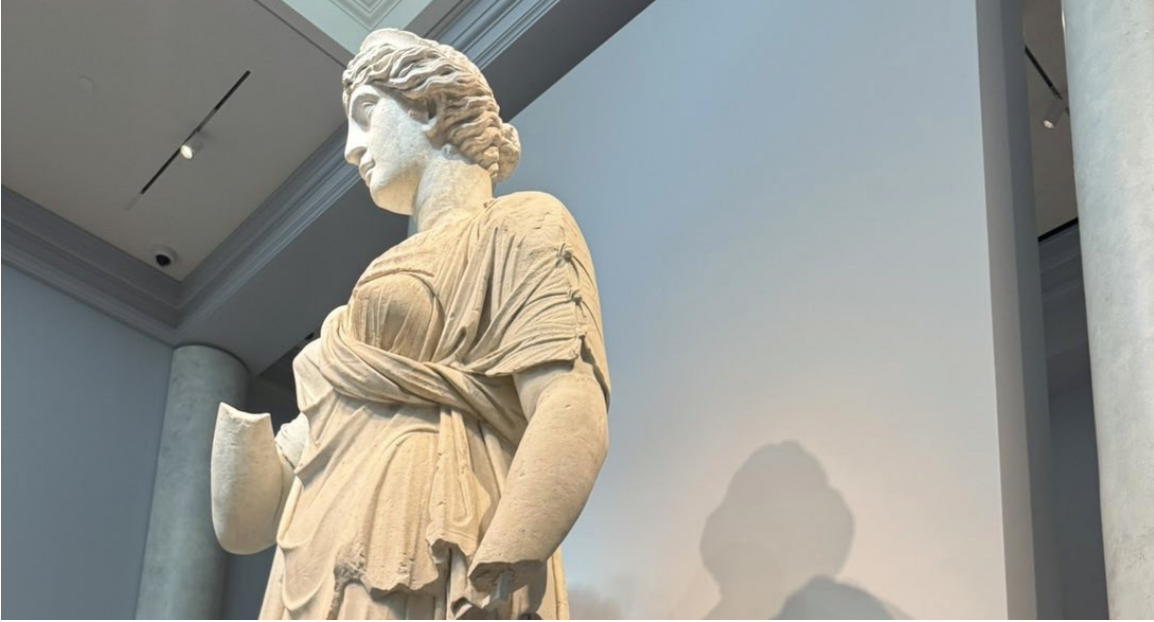

“And then you realize the Romans built this so, so long ago, but here it is standing right in front of you. You’re literally facing history,” Riley Meek ’27 said, describing her experience seeing ancient artwork in person during an art history field trip to the Museum of Fine Arts (MFA).
With museums, historic sites and urban spaces just beyond campus, Upper School (US) students have opportunities to experience their coursework firsthand. Through field trips, students are able to engage directly with what they are studying, Riley said.
In art history, students visit the MFA to give approximately 15-minute presentations on artworks they have researched. Riley, who presented information on an ancient Egyptian coffin, said seeing the piece in person helped her see details that were hard to identify in photographs.
“You can see so much more when you’re there,” she said. “I could just see so many more symbols when I went there and saw it in front of me.”
Riley said the presentations encourage discussions among students and help them engage more deeply with both their own artworks they study and those their peers study.
“When you’re spending like 15 minutes looking at the artwork, and one of your peers is presenting it, you just absorb so much more information when you’re actually seeing it in real life.”
Art History Teacher Sasha Lyons said seeing the original artwork can create an emotional connection that classroom slides can’t.
“Art has power; it has an aura,” she said. “It does something to you, and it’s really hard to experience that from a slide. The actual artwork itself feels more meaningful. It sort of gets into your soul more deeply than a slide ever could.”
Beyond helping students understand individual artworks, Ms. Lyons hopes the trips encourage them to continue visiting museums on their own.
“Field trips make them museum-goers; they want to go back for more, and that’s a great thing,” she said. “Whatever they’re learning about in class, if they want to go and visit museums and look at art, then my work is done.”
Field trips are also part of US English classes. In US English Teacher Akemi Ueda’s Junior course, That Way Madness Lies, students visit Harvard Square to observe their surroundings and develop ideas for an essay exploring what they consider “mad” about society.
“I want them to make connections not only to the literature that they’re reading, but how do we see that in our society?” she said. “How do we define madness? What do we think about that?”
Ms. Ueda said the US’s location in Cambridge allows students to explore places close to campus.
“Part of going to this school is also taking advantage of what is in your immediate surroundings,” she said. “We’re in a city, but we’re also in close proximity to beautiful natural spaces or historical spaces.”
Audrey Buller ’28, a student in Ms. Ueda’s Junior course, said the trip helped her observe aspects of society she wouldn’t normally pay attention to and better understand the themes discussed in class.
“Especially when we’re talking about society, it’s really different to see it in your class and watch videos on it,” she said. “But then actually seeing the real world and it happening right when you’re watching it, it’s really different than just watching it in class.”
US Photography teacher Andrew Warren takes students off campus to explore photography beyond the classroom. While beginner classes usually visit Harvard Square, intermediate and advanced classes travel to photography exhibitions at institutions such as the Addison Gallery of American Art in Andover.
“What I usually try to do is make it an art appreciation experience,” he said. “For a lot of photographers, myself included, anytime I can get out of my normal daily routine, it gives me a fresh way of looking at the world.”
Aidan Ashaye ’28, who has attended both Harvard Square and Andover field trips, said taking photographs in new environments has encouraged him to pay closer attention to his surroundings.
“It gives you a chance to appreciate the scenery at a deeper level because you’re looking around and thinking about what would make a nice photo,” he said. “You’re trying to see how you could capture the essence of a place you haven’t seen before in one photo.”