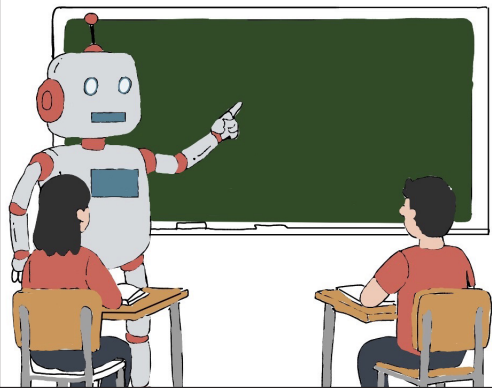
A few years ago, with the advent of AI, teachers moved take-home assessments and essays to in-class handwritten assignments to combat cheating. This year, the Upper School (US) moved in-class assessments back online, but with a twist: Respondus LockDown Browser monitors and restricts students’ access to outside sources. The Vanguard editorial board is split on whether this is a good addition. For more reading on the LockDown Browser, see “US tests LockDown Browser in classes” on page 1.
Locked Out ❌
Where did this new technology come from, and why?! The institution of the Respondus LockDown Browser felt like it just popped up out of nowhere, with no formal communication except for a quick announcement in advisory. And what was so bad before? We wrote by hand when needed, and if we needed to type, teachers monitored our screens. Cheaters will always find a way, so don’t punish other students by installing this annoying technology.
Students have two major stress points when taking a test or writing an in-class essay: how much time they have and what grade they’re going to get. The LockDown Browser increases anxiety over both of these.
First, the dreaded lag and setup. The browser takes a solid five minutes to set up out of a 45-minute block, which is a whopping 11% of the assessment time. And that’s only if it is working properly, which happens only about three-quarters of the time. Then, once you start typing, the first word appears only after you finish the second, and so on, creating an irritating delay. Typing increases efficiency, but with this lag and setup, it only slows us down.
Second, students want to maximize grades, which the browser hinders. Teachers, whether they recognize it or not, have subconscious biases when grading, which is why they often use a “blind” grading system; but with handwriting, the teacher can identify the student even without the name. This means that when some people use the LockDown Browser and others write by hand, students with handwritten essays could have an advantage or disadvantage depending on the teacher’s previous impressions of the student.
Students with typing accommodations are given a computer to level the playing field. But, with LockDown Browser, every student gets to type, meaning that people with learning disabilities no longer have a tool to make the assessments equitable for all. Also, students with learning profiles are often allowed to use Grammarly, but the LockDown Browser does not allow the tool to be used.
The LockDown Browser isn’t what US students need. We hope the school will go back to the original system.
—Scarlett Hawkins, Lucia Longstreet-Lipson, Harper Dubovik, Sydney Ruiz, Katy Varadi (all ’27), Pilar Bowen-Arce, Christian Chow, Noura Farahat, Lauren Li and Tristan Ko (all ’28)
Locked In ✅
Though the LockDown Browser has been a tough adjustment for students, it’s better than handwriting an essay with a mechanical pencil whose lead breaks every two seconds. Yes, the screen may lag every now and then, but is that really worse than the hand cramps that come with trying to write as many words as possible in a limited amount of time? Not only is typing faster, but it also makes editing easier. Instead of crossing out entire sentences or erasing words to replace them with better phrases, students can revise their work with just a few clicks.
And let’s not forget that the alternative could be much worse. Without the LockDown Browser, teachers concerned about cheating could impose stricter restrictions like prohibiting technology for all assignments. The browser limits opportunities for academic dishonesty without taking away the convenience of typing. It can also make take-home writing assignments possible by allowing students to work on computers while restricting access to outside resources.
In addition, AP English and History exams now include timed essays written digitally. If students are already expected to demonstrate these skills on major exams, shouldn’t they have opportunities to practice them in class? Many courses at the school aim to prepare students for future academic challenges, whether that’s an AP exam or college-level coursework. Learning to organize, write and edit an essay under timed digital conditions is a skill worth developing.
One could argue handwritten essays may receive more lenient grading than typed ones. But is that really a reason to return to handwriting? If anything, it raises questions about fairness. The fact that teachers can’t initially match a student to an essay helps ensure that students are held to the same standards. Students should be evaluated based on the quality of their writing, not who they are. Many teachers already use blind grading; the LockDown Browser having this feature isn’t a restriction but an enforcement we should already practice.
The sudden introduction of the LockDown Browser has been an adjustment, and nobody likes having more restrictions placed on them. Rather than eliminating the technology entirely, why not focus on making it work better for students? If the alternative is going back to handwriting every essay, we will take the browser any day.
—Mimi Shaywitz, Ethan Moran, Adi Bhatia, Christine Tao (all ’27), Rima Demir, Henry Carroll and Kate Tregay (all ’28)