Most high school students have been told some version of the same story: Work hard, go to college, earn a degree and find an entry-level job where you can learn how the professional world actually works. You probably won’t earn much or do anything glamorous, but that first job will give you the experience you need to move forward. But what happens if AI starts doing the work that was supposed to give us our start?
That question may sound dramatic, but it is becoming harder to ignore. Nowadays, everyone fears AI taking over human jobs, leaving us in the dust, and eventually turning us into the people from “WALL-E.” You hear horror stories of teens applying at fast-food restaurants and needing second and even third rounds of interviews just to flip a beef patty. Is AI really at fault?
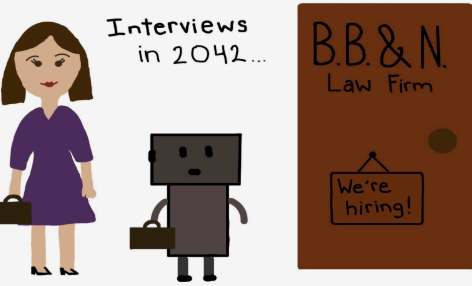
Before blaming it all on AI, which is now the default, let’s first go over what these models can actually do. AI is a powerful tool. It can summarize documents, conduct research, write code, prepare presentations and draft emails, all of which are the kinds of tasks often passed down to younger employees. If an experienced worker can use AI to finish them in minutes, a company might wonder why it needs a recent graduate. There are signs that young workers may already be feeling this shift. A July 2026 Stanford study found that unemployment among recent college graduates had reached 5.6%, while research highlighted by the Federal Reserve Bank of Dallas found a 13% employment decline since 2022 among workers ages 22 to 25 in jobs with the most exposure to AI.
These statistics are alarming, yet correlation does not equate to causation. Other confounding variables, such as an economic slowdown and the end of the post-pandemic hiring rush, may also contribute to the challenge young adults face in finding employment. Nevertheless, AI might be our version of the Industrial Revolution. In the past, machines have replaced the manual tasks performed by humans, resulting in job displacement while improving the efficiency and reducing costs of production. New industries and jobs were created, and there was a need for the workforce to adjust to these changes. AI technology is doing the same thing. Machines can not only perform physical tasks; they can also handle writing, coding, design and analysis — the intellectual tasks that are typically assigned to new hires.
The weird thing is that AI could be helpful to the experienced worker but, at the same time, could make things difficult for the inexperienced worker. The senior lawyer, programmer or financial analyst will know what kind of questions to ask and whether the answers are right, and therefore, AI will make them more productive. The recent graduate was probably hired because he or she had to provide the first draft that could be done by AI. The company could still need the senior worker who will supervise the process, but not so many junior workers beneath him. It would save money now, but in the future, where would the company find experienced workers if there are fewer people at the bottom?
Experts disagree about what comes next. Stanford economist Erik Brynjolfsson and his co-authors found that “entry-level employment has declined in applications of AI that automate work,” suggesting the first effects may already be hitting young workers. Goldman Sachs economists Joseph Briggs and Sarah Dong are less worried. They argue that “predictions that technology will reduce the need for human labor have a long history but a poor track record.” Either way, our generation may need to show experience before getting the entry-level job that once provided it. Rather than searching for an “AI-proof” career, students should build judgment, creativity, communication, leadership, collaboration and knowledge of a particular field.
So, to everyone reading this at school: Don’t let AI convince you there won’t be a place for you in the working world. Learn how to use it, but keep developing the things it cannot give you: judgment, curiosity, creativity and the ability to work with other people. Our first jobs may ask more of us than they asked of generations before us. That may not be fair, but it doesn’t mean our future is gone. It just means we need to start preparing for it now.