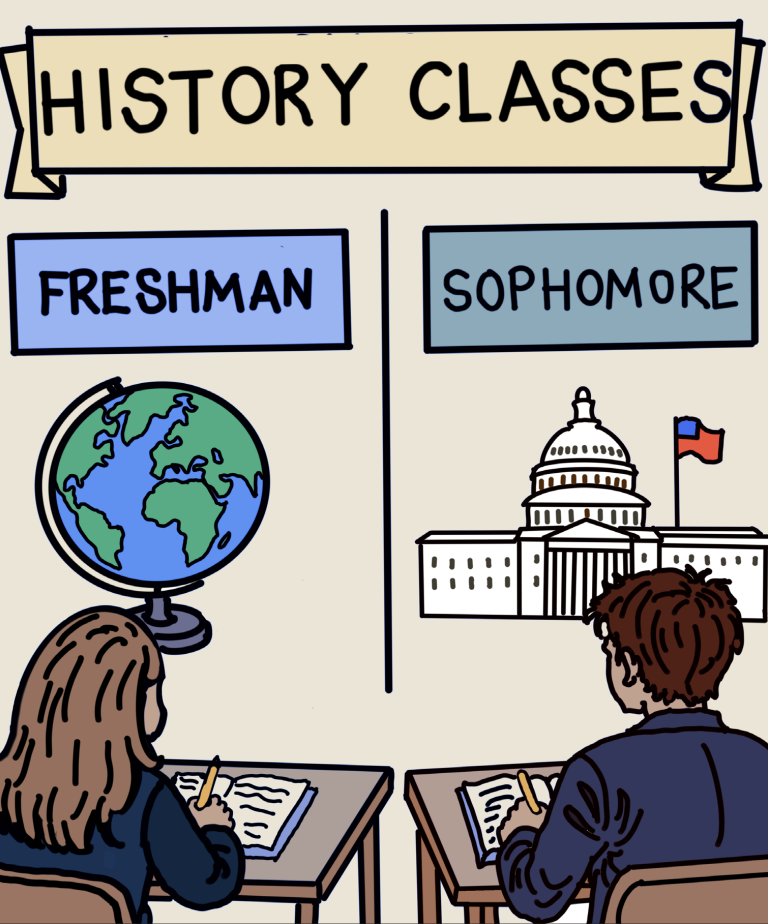
This year’s freshmen will be the first to experience a newly designed Global History I curriculum. After years of discussion, the Upper School (US) History Department has redesigned the course, changing what students study and the order in which they study it.
In the fall, students will cover case studies focusing on India, the Congo Slave Trade and the Atlantic Slave Trade. After their exam, students will study the Holocaust and the Cold War before writing their research papers in the spring. Students used to read the Holocaust memoir “Night” by Elie Wiesel for summer reading and dive straight into learning about the Holocaust.
The history department had discussed changing the curriculum since before the pandemic, and they finally agreed on a plan in May.
US History Department Head Dr. Stacey Spring said the department will prioritize chronology and connections between historical events. Students will learn about the rise of Hitler in the broader context of the world wars while adhering to the course’s through line: human rights and community.
“I want people to encounter countries and peoples as themselves, as opposed to starting the story when they’ve been conquered,” she said. “It was hard for most of us to wrap our heads around starting with the Holocaust, and then doing ancient history.”
While this year’s sophomores can expect a similar curriculum as previous years, the Global History II course will be altered next year to avoid overlapping concepts.
“Our number one priority is making history exciting and relevant,” Dr. Spring said. “We want students to understand why they’re studying what they’re studying.”
She said student feedback and other factors, such as students’ writing progress, will help the department evaluate the curriculum’s success.
“If the curriculum still comes up in their future courses and students are able to identify these connections, then we’ve met our goal of a memorable class.”
US History Teacher Dr. Susan Glazer said students will still write research papers, but rather than selecting a topic from ancient history as in past years, they will choose from a narrower modern time frame.
“We wanted to create space for student choice in projects and student leadership while making it manageable,” Dr. Glazer said.
Mabel McClatchey ’29 said the curriculum could benefit from these changes.
“I enjoyed what we learned in Global History I, but I think that updating the timeline of the class would make learning more straightforward,” she said.
Ilsa Shrag ’28 agreed that the new curriculum will give students a broader perspective while creating a more steady learning experience.
“A changed curriculum feels fresh,” Ilsa said. “If everyone, especially teachers, is excited for an updated class, future students will gain an appreciation for history.”