On Friday, May 22, Upper School (US) Director Jessica Keimowitz sent a long-awaited email to parents, faculty and students detailing the new phone policy going into effect for the 2026-27 school year. The policy, described as an “off-and-away” restriction, was the culmination of a year of surveys, discussions and meetings.
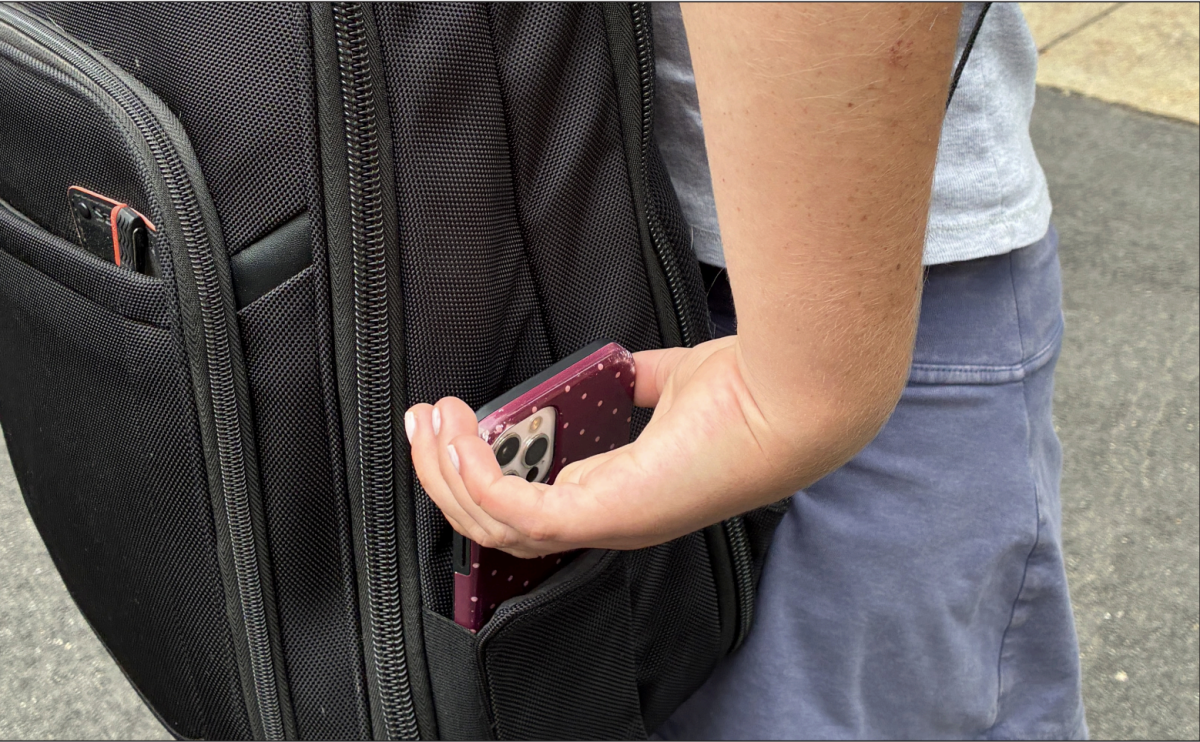
The new phone policy requires students to keep their phones in their backpacks or lockers while on campus from 8 a.m. to 3:25 p.m. There is also a complete ban on all technology, including computers, in the Commons during first and second lunch. Teachers will enforce the policy through a warning system, Ms. Keimowitz said.
“Teachers will be able to say to a student, ‘I see that you are on your phone, you really can’t be on your phone. Can I have your name please?’ We’ll keep track that way,” she said.
Ms. Keimowitz said that after two warnings, the student’s parents will be notified and, after three, further consequences, such as losing off-campus privileges, will follow.
The new phone policy follows a growing trend of similar policies in neighboring schools, Ms. Keimowitz said.
“The pendulum has been swinging in schools around the country,” she said. “Many, many states have passed cell phone bans for public schools statewide, and many of our peer independent schools have been working on cell phone policies for several years.” Fellow Independent School League (ISL) school Thayer Academy has a similar bell-to-bell ban, but instead of requiring all phones to be in backpacks, students lock cellphones away in Yondr Pouches. Tabor Academy requires students to leave cellphones in cars, lockers or, being a partial boarding school, in dorms. Massachusetts is currently in the process of passing a law banning cellphone use in all public schools.
Ms. Keimowitz saw issues with US students on their phones.
“Between looking at lunch tables and seeing kids sitting together but not actually talking to each other, watching people walk through the halls but their phones right in front of their face and really worrying about what that’s doing to community interactions, to our ability to interact with each other, we felt it was high time to revise the policy,” she said.
Ms. Keimowitz acknowledged challenges may come with a transition.
“It’s really hard to change culture and behavior, especially coming off of the summer when many of us have had unlimited access to the phone and a lot more time to spend on it,” she said. “I don’t want to say that the phone is all evil, it’s not. It does a lot of useful things, but I think we need to really focus our efforts on building community and human interaction. I think that’s the solution to many of the issues that we’re facing in this world and this is one way to do it.”
The school will administer another survey to students in January to assess the policy’s effectiveness, she said.
“I will be really clear with students that I am seeking feedback all the time, whether it’s a formal survey or not,” Ms. Keimowitz said. “If students want to come talk to me or talk to their advisor who’ll come talk to me about a concern that they had, that’s absolutely fine.”
Tabor Academy Head of School Tony Jaccaci oversaw the implementation of the school’s cellphone policy two years ago. After receiving feedback from students, this year they are allowing phones to be concealed in students’ pockets for safety reasons. He said their policy is meant to serve their students, not punish them.
“Students should not feel bad about feeling connected to their telephones,” Mr. Jaccaci said. “You guys aren’t at fault because you want to use your phones. These social media and handheld devices are built for that, and you have all come of age when it’s been very easy to access them. So, when I think of these policies, it’s not a punishment because students are weak in character or something like that. It really is trying to reprogram the brain and reprogram the behavior towards these devices.”
At the US, the student response to the new policy has been mixed.
“I was kind of surprised that there was a new policy being implemented because I didn’t really think that there was a major issue within the school regarding the phones,” Kaeleigh Neil ’27 said.
According to the cellphone survey results shared in the email announcing the new policy, students echoed her sentiments, with 73.4% of students saying the previous policy was “just right” and 97% of students agreeing, strongly agreeing, or staying neutral with the statement that they are “satisfied with the school’s cellphone policy.”
The faculty, however, had a different response, with 94.2% saying the policy should be a little or much more restrictive.
US Dean of Teaching and Learning Michael Chapman said both perspectives were a big priority when creating the policy.
“This is a policy that affects us as a community, and it should not be simply something that comes from on high or something that excludes constituencies that are going to be directly affected by this,” he said. “From a faculty perspective, the general sentiment is this is something that’s really important. From listening to students, there is a loss because being able to have your cellphones in different places and spaces has been around for a while, so there is a loss of familiarity and normalcy.”
Katja Rankel ’28 said she wasn’t surprised by the new ban.
“This is a controversial opinion, but I think it is pretty reasonable. I’ve noticed a lot of people always on their phones during lunchtime and on the couches in the library. It makes sense,” she said.
Katja said the restrictiveness of the policy is necessary.
“It’s hard for people to make a rule everyone will respect, so they kind of had to go harder than we were all expecting,” she said.
Katja hopes the policy will encourage bonding among peers.
“There’s going to be a lot more opportunities to have conversations throughout grade levels, but also just our grade, to have more sincere conversations, not distracted by as much,” she said. “That’ll be cool. It’ll be interesting to see if our grade gets any closer because of it. That could be a positive thing.”
Thayer Academy Head of School Chris Fortunato said he noticed a meaningful mood shift on campus after their Yondr Pouch requirement was implemented.
“We noticed a significant change in the tone and tenor of the campus,” he said. “We saw kids interacting with each other and playing cards and doing various things in a space that felt more consistent with what we were hoping for.”
US Math Teacher Amelia Mattern was a part of the faculty and student discussions Ms. Keimowitz held. She supports the policy but acknowledges the transition will be difficult.
“The first two to four weeks will probably be the hardest,” she said. “I have friends who work at other schools who have done stuff like this, implemented policies, and they have said that the first several weeks are really hard, and after that everything gets better. The students enjoy school more, and the faculty and staff enjoy school more.”
Dr. Mattern said she understands students’ skepticism but is optimistic that the policy will make the US a better place.
“I’m really hopeful that this is going to help our community,” she said. “I understand that students are feeling upset by it and I totally get it, but I think it’s the right decision.”