The email arrived around 10 p.m. on a Saturday. One junior had spent the last weeks of trimester two raising his AB Precalculus grade up from a B+, earning an A on one test and an A+ on the next. He thought it would be enough to appeal for his long-standing goal of taking AP Calculus BC. He opened the email.
“Your request and materials have been reviewed by the Appeals Committee, and your appeal to move from AP Calculus AB to AP Calculus BC has been denied,” the email read.
This junior, who spoke anonymously to preserve relations with faculty, was one of more than 90 students who appealed their course placements this year under a new standardized process, according to Upper School (US) Director Jessica Keimowitz. The system, designed by US Dean of Teaching and Learning Michael Chapman alongside Ms. Keimowitz, replaced a path in which students could push back through their teacher, department head or the US office, with no official system in place.
Now, any students who wish to appeal complete an in-person form that asks about workload management and motivation. Once submitted, every appeal now routes through a committee of three to four reviewers, including the student’s teacher. One of three decisions is returned: approved, postponed until the end of the trimester or denied.
The Vanguard reviewed the junior’s email, which appeared to be a standard letter sent to students who were denied.
“I opened it on a fine Saturday evening, and it was just a no,” he said. “It just felt like a song and a dance. The only thing that really changes anything is your grade.
“It kind of feels like it prevents parents from freaking out at the teachers. It takes the burden off the teacher,” he said. “But then it takes away your ability to advocate for yourself. To me, it seemed more in the teacher’s interest not to have to deal with parents rather than the students.”
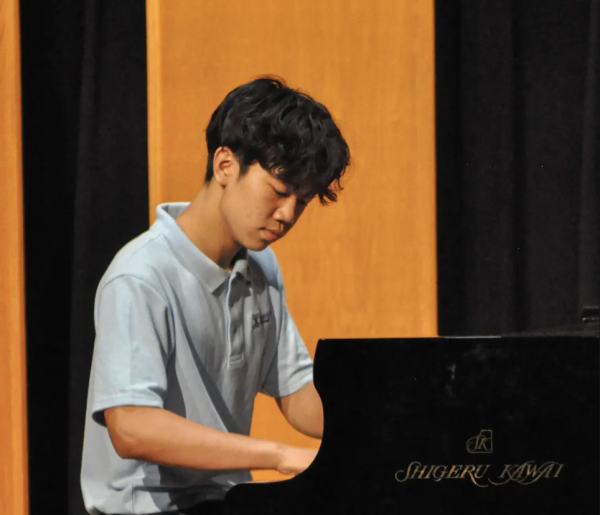
Davis McCullough ’28, who filled out the appeals form to advance in physics levels, said he was still waiting for a decision. He was not. Asked to check, he opened his email and read his decision aloud for the first time.
“Oh, appeal the decision. Right there,” Davis said. “Thank you for completing all parts of the appeal process. Your request has been reviewed by the appeals committee, and a decision has been put on hold until the end of the trimester.”
He processed it in real time.
“I think it’s saying if I can get my grade back up, then I’ll be able to move up,” he said. “They’re waiting for that, so it’s dependent on how I do the rest of the year.”
The grade in question, he said, was dragged down by a single class-wide low on a test that could not be retaken. He said he felt ahead of his classmates most of the year.
“I was understanding everything pretty quickly and was helping my classmates understand stuff,” he said. “It definitely gives more freedom to a student, even if they’re not approved to go up by their teacher, to get a second opinion, which is good, like with my story.”
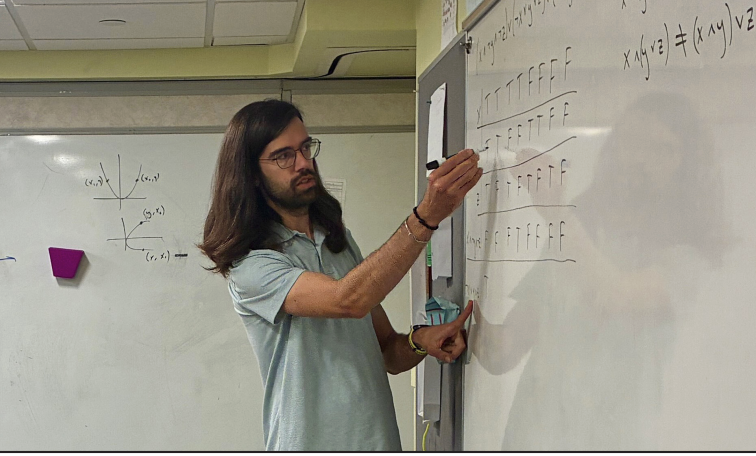
US Math Teacher Chip Rollinson heads the math department appeals committee. He said the old system did not work the same way for everyone.
“We realized that some kids and families would feel more comfortable pushing back on our recommendations,” Mr. Rollinson said. “And there were some students who didn’t know that they could advocate for themselves. This system makes that advocacy more accessible for students who might not have had the chance previously.”
Predicting a student’s future performance is difficult, he said.
“We don’t have crystal balls. But we root for each student’s success in whichever course they end up taking.”
Another junior, whose name was not included to preserve her relationship with faculty, entered the school in ninth grade without the same math preparation as her classmates had.
“My grades weren’t the reason why I had to appeal in the first place,” she said. “It was because of my transfer background, and that’s what my teacher was concerned about. But it’s good that they have it.”
For Ajay Shroff ’28, the process worked. His teacher told him she would support an appeal if he raised his chemistry grade. He raised the grade and received an email stating that his appeal for AP Physics 1 was approved.
“I think the form honestly had less of an impact than other things,” he said. “I’m moving down in another class next year so I can make space for the AP, because my advisor said he didn’t want me to do too many AP classes, especially if I’m moving up in one of them. So I think that is part of the reason I got approved.”
Mr. Chapman said the committee’s decisions are not based solely on whether a student is academically capable of succeeding in a harder course but also on how the increased workload could affect other parts of a student’s life.
“Moving into a class that’s going to take so much extra time outside of class to just stay afloat – that energy doesn’t just magically appear,” he said. “You have to take it from other places. What happens to your other responsibilities? Time is a finite resource.”
Standardizing the appeals process will deliver statistics the school didn’t have before, including how students who appeal go on to succeed in the course, Mr. Chapman said.
“The system was made to be something every student can utilize,” he said. “We are trying to ensure that the maximum number of students who feel they have the potential to be successful have those doors open to them.”
Ms. Keimowitz said the committee also considers student well-being.
“No teacher wants to tell a student they can’t do it,” Ms. Keimowitz said. “But the real question is, at what cost? How much sleep will you lose? How much stress will you endure? For me, it’s not ‘You can’t do it,’ but ‘Is the cost worth the benefit?’”