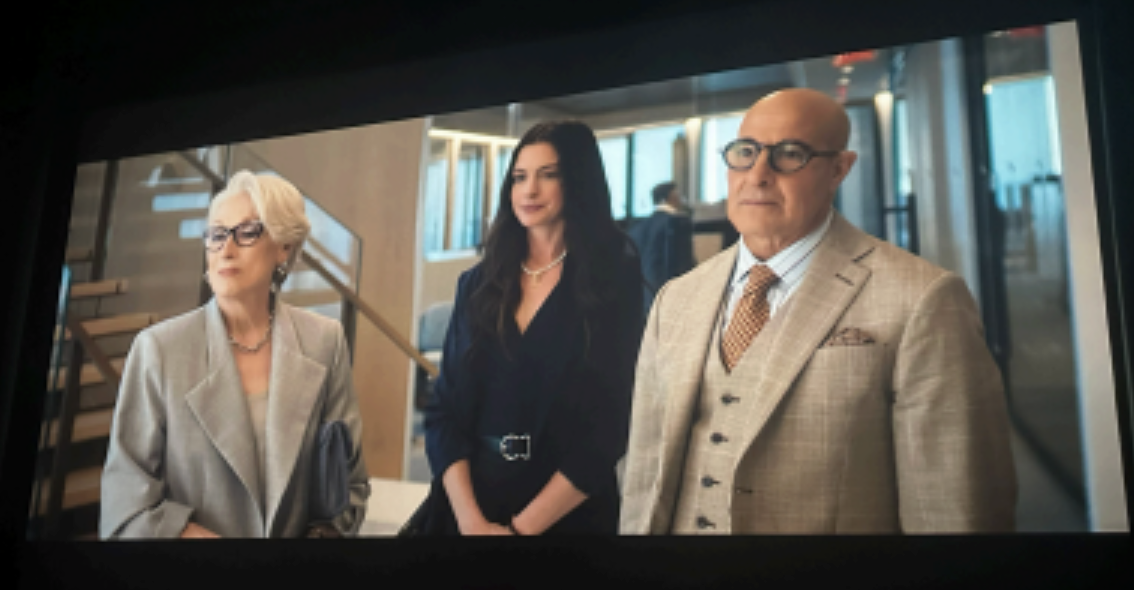
Right before Andie Sachs (Anne Hathaway) walks up to the stage to accept a journalism award for her work at a newspaper called … wait for it … The New York Vanguard, she finds out that all of the journalists there have recently been laid off. Andie finds her way back to working for the devil herself, Miranda Priestly (Meryl Streep) at Runway magazine, where she navigates a declining print magazine industry, AI, corporate takeovers and threats from Miranda’s former assistant, Emily (Emily Blunt), who now works at Dior.
“The Devil Wears Prada 2” has all the right components of a good movie: Lady Gaga songs, colorful outfits, Meryl Streep, a trip to Italy and celebrity cameos. Yet it never quite captures the same charm and nostalgia as the original “The Devil Wears Prada” that aired in 2006.
The overarching theme in “The Devil Wears Prada 2” is the importance of art and journalism in an increasingly digital and corporate society. Andie was originally hired to help Runway recover from a damaging scandal, but her role as the features editor expands beyond crisis management. As leadership changes at Runway and a young profit-focused businessman takes over and tries to cut funds for Runway, Andie fights to preserve journalistic integrity and original reporting in an industry increasingly dominated by algorithms, AI-generated content and engagement metrics. This theme resonated with us at The Vanguard.
The main problem with “The Devil Wears Prada 2” is that there is too much going on. The film introduces multiple side plots and character arcs, but very few of them are developed enough to feel meaningful. As a result, the story feels overcrowded and unfocused. The largest conflict of the movie, the potential sale of Runway magazine, arrives too late in the film and seems rushed. It began during the last 30 minutes of the film, and was resolved within two scenes. Afterward, the movie hurries through the endings of several unfinished storylines, making the conclusion feel unrealistic and overly convenient.
For example, Andie meets a love interest on the way, they spend at most three short scenes together, and in that small amount of time get together and then break up. Then, within the last 10 minutes, the writers include a two-minute scene where they get back together. This side plot, along with others, doesn’t make sense because it is condensed. It also doesn’t feel necessary to the overall storyline of the movie and Andie’s growth as a journalist.
Although parts of the plot felt confusing, the costumes and set design were a very nice distraction. Unlike the original film, where Andie slowly adapted to the fashion world, she now fits in completely, wearing chic designer outfits, colorful dresses and modern runway-inspired looks. Along with that, the set changes, which vary from Met Gala red carpets to extravagant seaside mansions, aided in holding our attention for the two-hour film.
The best scene in the movie is when Nigel, Miranda’s longtime assistant, gets to run the magazine’s fashion show in Italy after Miranda suddenly leaves midway through. Nigel has always written Miranda’s speeches and watched her from the sidelines, so his opportunity to step into the spotlight and get the recognition he deserves is a satisfying and complete resolution of his story arc.
Overall, the movie was an entertaining but overcrowded sequel that didn’t fully live up to the beloved writing of the original. While it succeeds at touching relevant themes, it attempts to tackle too many ideas and plots at once. Still, the strong performances from lead characters, along with impressive fashion and set designs, made the movie enjoyable, even when the plot fell apart.