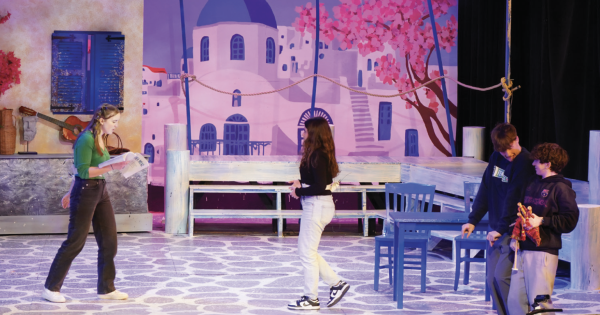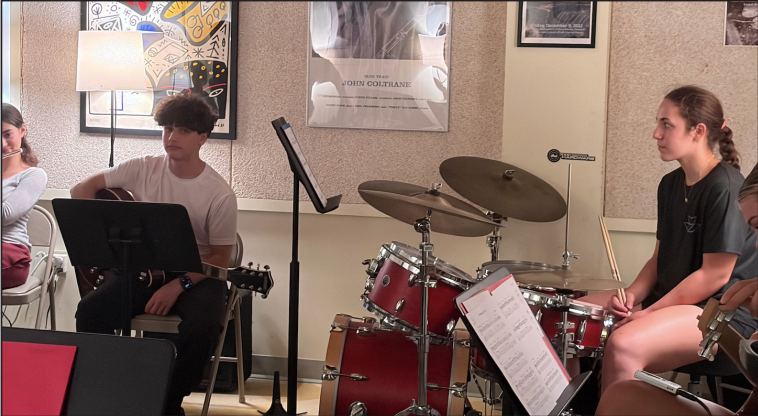
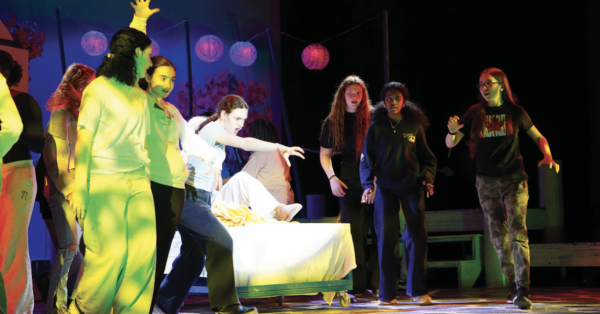
As the final curtain fell and the actors took their bows, the audience erupted in applause. Backstage, 24 students quietly dismantled sets, moved props and organized the stage for the next performance. From March 5-7, the Upper School (US) put on a production of “Mamma Mia!”
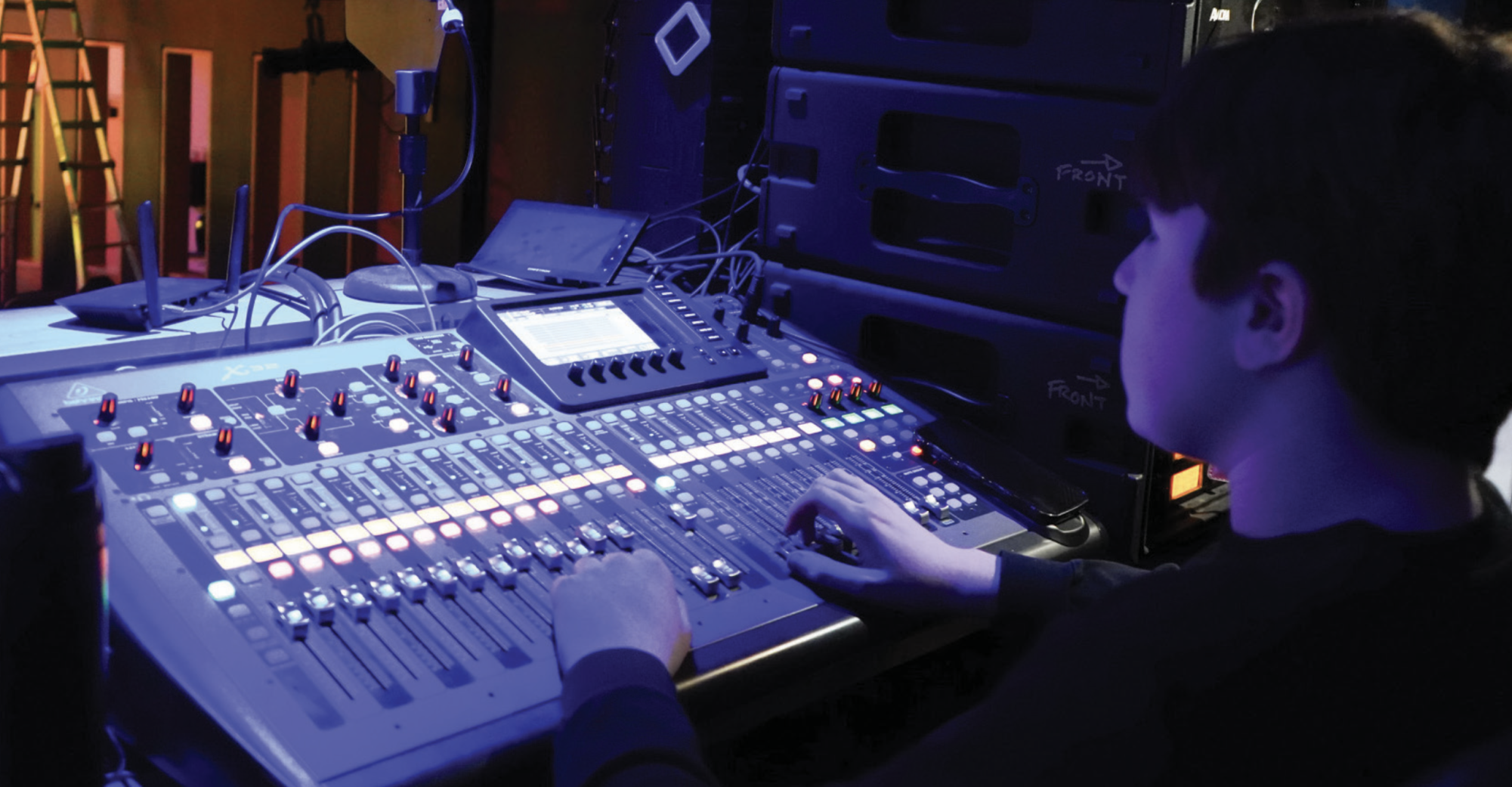
While the audience witnessed two hours of choreography and music, the backstage crew members — including stage management, stage crew, costume crew and the pit band — spent months constructing moments that lasted only minutes.
“We first brainstormed and had to look at what specific locations were needed, a two-meeting process that took three hours,” Assistant Set Director Leo Saul ’28 said. “There were so many people involved in making the decisions and process, and the audience might only see that set for five minutes.”
Backstage members met for three 90-minute rehearsals each week, a commitment that swelled to five to six sessions a week as opening night approached.
US Arts Department Head Adam Howarth and Leo planned scenes for months that briefly appeared on stage.
“Mr. Howarth really listened to me and collaborated like we were a team,” Leo said. “We thought through presentation together, and that was a cool process and compromise to be on the same level.”
Sam Minsky ’26 and Sydney Ruiz ’27 created the set’s backdrop, which took 12 90-minute sessions.
“The painting process was the most time-consuming when making the set,” Leo said. “It’s just a background that the audience sees for a few seconds and then forgets it’s there.”
After the set was finalized, students worked on costumes, Costume Designer Ara Surati ’29 said.
“One thing the audience would never notice is all the time that goes into making stencils for each clothing item. Each item has to be printed and cut out with precision. Because clothing is larger than an 8-and-a-half-by-11-inch area, it has to be lined up exactly and taped, so some pieces use 60 sheets of paper. If you make a mistake or if it wasn’t lined up correctly, the whole area has to be retaped.”
David Xiong ’26 practiced two to three hours a week for his role in the “Mamma Mia!” pit band.
“It started as a separate practice, but during rehearsals and production, we worked directly with the actors,” he said. “You can’t just read the notes and count the beats. You have to follow what the actors are doing. There were pauses and stretches where nothing was written on the page, so musicians needed to pay attention to cues. Each production is slightly different, so there is more adaptability and playing on the fly.”