I didn’t spend any time in my bedroom growing up. Neighborhood kickball and football games kept me outside. We never wore shoes; only tie-dye shirts and drawstring shorts. So when I stared down the school’s in-person application essay prompt: “In three paragraphs, write about your favorite room in your house,” I was at a loss. Something is better than nothing, I remember thinking, before randomly titling the work “My Room.” I felt bad for the admissions officer who must’ve sat down at his desk, interested to hear bright 11-year-olds from New England describe their favorite place. Not only did structure and organization get the better of me, but the essay was a weak attempt to describe a room that hardly felt like it belonged to me.
I wrote hollowly about my twin beds and gingham curtains. Looking back, the three sentences about the artwork that hung over my desk were the only ones of substance. The Easter before writing my application, I had spent three hours painting hundreds of interlaid circles in different colors onto a massive piece of cardstock. At the time, I didn’t think anything of it. I had a free afternoon, so why not? My mom had called it a “cluttering of Olympic rings.” Really, it was the start of a pattern of expressing thoughts and feelings through artwork that could show just how massive they were.
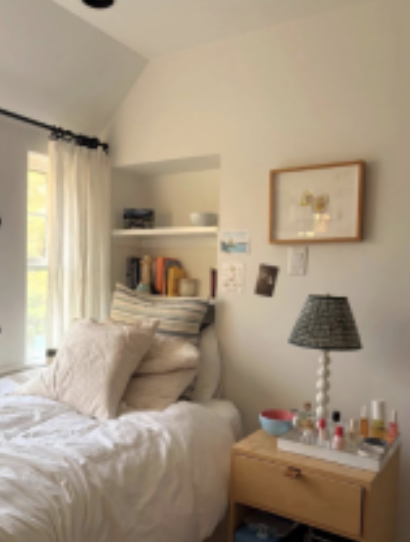
Six years later, I have a better shot at writing about my room. Because, of course, juniors spend the majority of their time in three places: school, the car and their room. My mom designed the room to be a geometric puzzle, with beams that jut through the ceiling, parallel to the eight-foot-tall green cutout. It’s her personal project: The green accents in the rug, bedspread and curtains are all her doing.
She, however, left the accessorizing to me. I’ve covered the white walls with Polaroids and posters of Diet Coke or the movie “Ferris Bueller’s Day Off.” Don’t look too closely at the rug — I’ve stained it with paint and frozen yogurt. Crumbling flowers collect dust on my bedside table next to a small plastic flamingo. You might think the music is playing from the record player, but no. That’s broken. Dave Matthews’ voice comes from my mini JBL speaker. That dent by my window bed? That’s from throwing my alarm clock one morning last November. Indented shelves house every book from my childhood, from “If You Give a Mouse a Cookie” to “Look Both Ways” and “Anna Karenina.” To my mother’s annoyance, I’ve piled up all the kitchen spoons on my dresser, unwilling and unlikely to ever bring them back downstairs.
 “Yes, I have different relationships with the room I grew up in and the one I live in now. But both have been privy to the system I’ve created to synthesize my thoughts. Both have become an offset version of my mind.”
Those are the focal points and trinkets you’d notice after spending time in my room. But what stands out most are the one hundred 8-by-11-inch pieces of paper that cover the wall above my desk. I’ve named the mural “The Writing on the Wall.” Each page is packed with arrows and diagrams so that when you take a step back, all you see is an ocean of graphite. It started as a joke competition to see how much I could write down to prepare for the December exams. Any person who needs to write and rewrite content for it to stick knows that studying produces study guides and notes — but also blisters and calluses. Two pages a day became three, and suddenly, my mom opened the door in February and said, “Good heavens!” in that Atlanta way of hers. We stepped back together and looked at the crowded wall.
Without realizing it, I had created a spin-off of the mural I painted as a kid. Both are organized messes — one with interlaced rainbow rings and the other with linked ideas in graphite. The walls where I’ve hung the “cluttering of Olympic rings” and “The Writing on the Wall” have provided a space for my thoughts to leave abstraction. Yes, I have different relationships with the room I grew up in and the one I live in now. But both have been privy to the system I’ve created to synthesize my thoughts. Both have become an offset version of my mind.