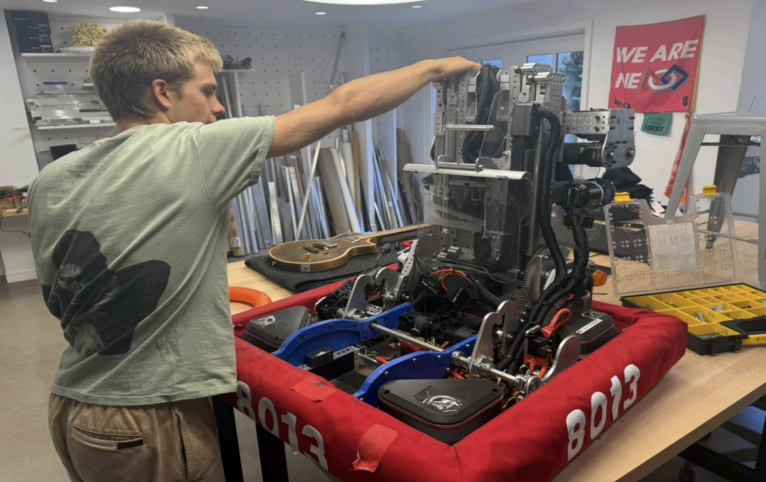
Previously, the Upper School (US)’s VEX Robotics team operated out of a borrowed engineering classroom, with its only storage space being a makeshift area under the staircase in the science wing. This winter, the US will officially gain a separate FIRST robotics team, which has competed at the World Championship in Houston and has spent the last six years working in the family robotics lab of Quinn Conine ’27. Both teams will move into something neither has ever had: a new building of their own.
Construction began this summer on a new robotics and innovation lab as an extension of the woodshop, US Chief Learning Officer Jed Lippard said. The lab falls under the innovation strand of Bright Bold Next, which is the school’s fundraising campaign. Dr. Lippard said it is expected to be completed during the school year, and it will house both the fall VEX Robotics team and a new winter team competing in the FIRST Robotics Competition.
“It’s certainly going to be a place that gives our robotics teams adequate space on campus for preparing for competitions, but we don’t even know the full potential of what the space might become as it settles into our campus master plan,” Dr. Lippard said. “There’s a lot of care at BB&N for students who are passionate about the arts and sports, and this augments those opportunities for students who are really interested in design thinking, robotics.”
As the lab’s construction is underway finished, the US plans to hire a teacher to develop the robotics program and eventually teach future classes that may take place in the lab, Dr. Lippard said. The school is also exploring the relationship between participation in interscholastic robotics and the team sport requirement currently in place, he said.
“Part of what we’re committed to is students having a team experience that requires collaboration, working together toward a common goal, engaging in physical activity,” he said. “It’s a really exciting time for BB&N.”
The FIRST team did not start near campus, Quinn said.
“We used to work out of our house. I’m graduating this year, and I’m the last of that original FIRST group,” Quinn said. “The lab expansion originally started because we wanted to hand it off to BB&N instead of just ending the program, and a lot of the FIRST values are about carrying on the program.”
FIRST stands for “For Inspiration and Recognition of Science and Technology.”
“In sports, you have big figures like Ronaldo,” Quinn said. “There’s not much of a difference in STEM. The mission of the new lab is to push toward that feeling of inspiration in science and technology.”
David Zhou ’28, an incoming captain of the fall VEX Robotics team, said that FIRST and VEX will remain separate programs.
“There has already been a team outside of BB&N for FIRST,” he said. “And what they’re looking to do is pass on that team to BB&N because everyone on that team right now is part of BB&N. So we will have two Robotics teams. There’s VEX, and then there’s also FIRST.”
The two teams differ in their spatial needs, which the lab plans to help with, David said.
“The thing with FIRST Robotics is it takes up a lot of space. It’s like a tennis court. The games are huge,” he said. “I don’t think the engineering room is large or tall enough for what’s needed, especially since some of the FIRST robots can get close to human-sized. A new building would definitely help provide the space to design, build and test them.”
Incoming VEX Robotics captain Jonathan Harlev ’28 is excited for the team to share a larger space. He said a visible home for robotics could change impressions of the program.
“The football team has a field and the soccer team has a turf field. A visible demonstration of a team can definitely get people excited to sign up for something,” he said. “It gives us validity and having a space gives it a bigger sense that it’s an actual thing.”