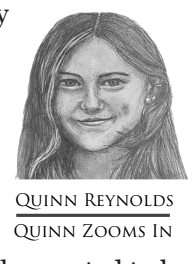
To quote “The Great Gatsby,” which you have most likely read or at least SparkNoted: “I like large parties. They’re so intimate. At small parties, there isn’t any privacy.” You, my readers, are my large party. I write to you about the worst of the worst.
The funny thing about true crime, a sentence that is an oxymoron in and of itself, is that it’s hard to fathom. It’s hard to imagine how ordinary moments tilt into something that changes the course of someone’s life. These stories have no scale. They happen in kitchens, in parking lots and in bedrooms that look like yours. That familiarity is what unsettles me most.
So I write, and I presume you read, not because we expect to understand violence but because reading in a crowd — a large party — lets us look from a distance. I watch my documentaries shrouded in the comfort that I will probably die someday from natural causes.
While ignorance is often bliss, writing, reading and watching these stories has taught me that distance is an illusion. For me, true crime has never been about spectacle. It has been about proximity and about using my large party to make the unbearable feel manageable.
Being obsessed with true crime also makes me feel safe. I operate under the belief that expecting disaster disqualifies me from it. What are the odds that the noise my washing machine makes in the middle of the night is actually someone climbing through the window? Anticipation — my acute anxiety that my sister’s late arrival means kidnapping and not dodging salmon served for dinner — is my weapon.
Now, as I bid farewell, I want to thank my readers. Do you guys exist? I know for a fact that Ella Namiranian ’26 — my best friend and biggest fan — reads my columns. And Ms. Hudson, who apparently enjoyed reading about husband killers!
If you’ve made it this far into my large party, you deserve something practical. For my last column ever, I would like to impart my top three favorite true crime documentaries. Maybe you’ll eventually stumble across some free time.
While not technically a true crime, an honorable mention goes to “Free Solo.” Released in 2018, it follows Alex Honnold as he attempts the first free climb of Yosemite National Park’s El Capitan. As a former competitive rock climber, I found this documentary truly riveting and free of gruesome murders or violence. Spoiler: He stays on the wall. Honnold has recently been back in the news, receiving backlash for free-climbing a building in Taiwan. You can try to cancel a guy for not having a properly functioning frontal lobe, I guess.
Now for the podium. Third place goes to “American Manhunt: Osama Bin Laden.” This documentary, which follows the United States’ mission to capture bin Laden, is three spectacularly produced Netflix episodes that made me embarrassingly patriotic.
Second is “Athlete A.” I watched it years ago, when my family’s Wi-Fi shut off at 9 p.m. I was so riveted by the exposure of Larry Nassar and the USA Gymnastics cover-up of his sexual abuse of young girls that I tiptoed to my mom’s phone, connected to a hotspot and watched long into the night. It scarred me and, for the first time, made me acutely aware of the cruelty in our world.
My favorite documentary is “The Perfect Neighbor.” I would attach a massive trigger warning to it. Like many of the documentaries I’ve written about, including how O.J.’s lawyers exploited racial tension in Los Angeles to secure a not-guilty verdict, it gestures toward broader political issues. This one is about gun control, and it will make you hate America again.
“For me, true crime has never been about spectacle. It has been about proximity and about using my large party to make the unbearable feel manageable.”
As a self-proclaimed true-crime columnist, I have some final words of wisdom. If you don’t want to be a victim in a documentary, don’t be charismatic. Definitely don’t light up the room. Maybe don’t get married if you can help it. But coming from me, as a person, take risks. Be a dissenter. Don’t let yourself be censored or overly influenced by the people around you. And don’t give in to your arguably biological instinct to be mean to your mom.