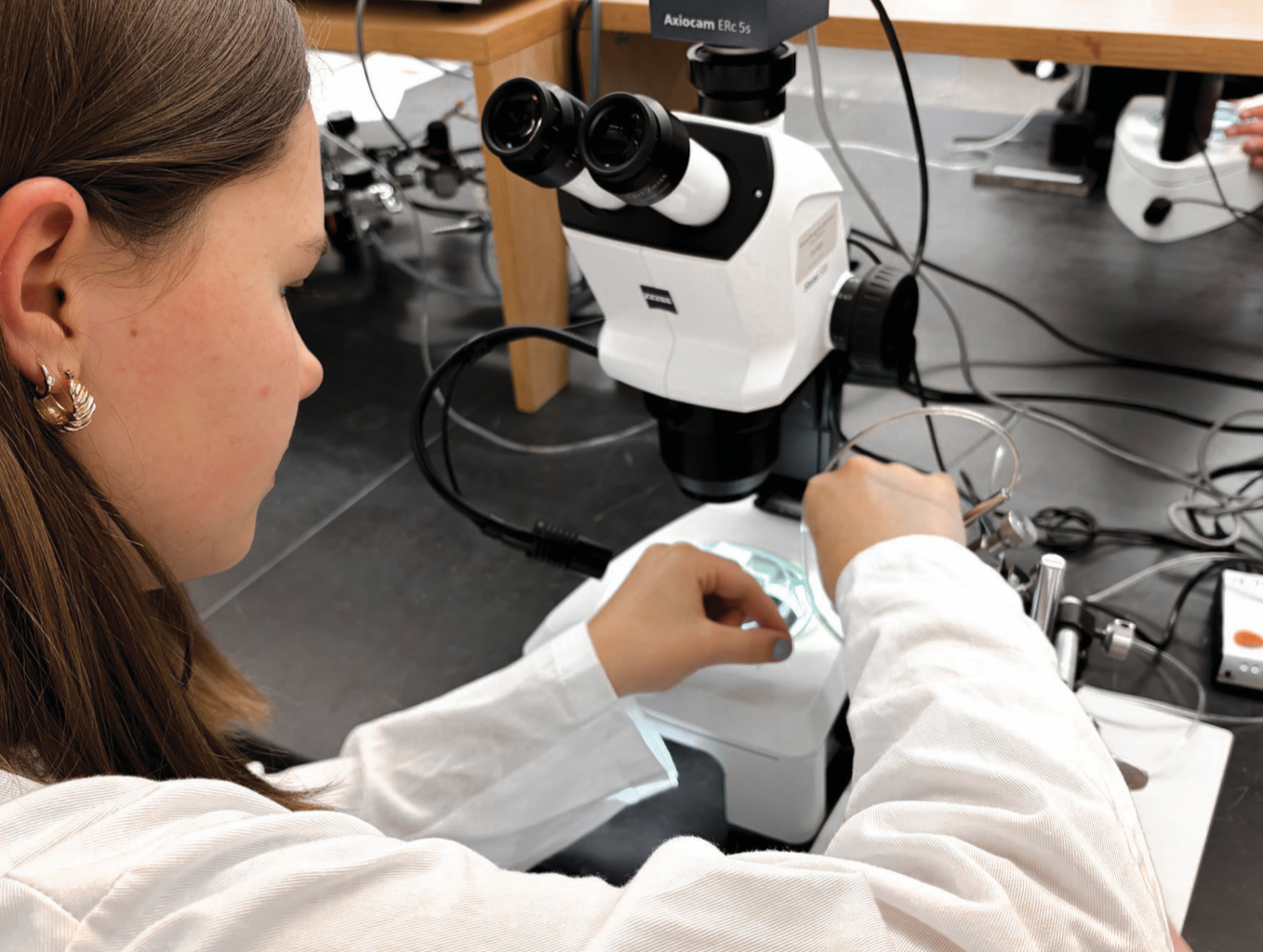
Working at the Marine Biological Laboratory in Woods Hole, Annie Zhu, Sylvie Welu and Amanda Berlin (all ’26) spent Feb. 4-7 injecting zebrafish embryos. The marine biology program provided 10 students from the Upper School (US) and Thayer with hands-on experience in CRISPR-Cas9 gene-editing technology. US Science Department Head Stephanie Guilmet and US Science Teacher Jenn Gatti organized the trip after the annual Girls Advancing in STEM (GAINS) conference did not run.
CRISPR-Cas9 allows scientists to modify DNA and has implications for medicine, agriculture and disease research.
“We do the CRISPR lab in ninth grade, but we use isolated DNA in a test tube,” Dr. Gatti said. “It is a great way to introduce students to CRISPR, but it is not the same as testing it in a real organism and then looking at the outcome once they develop like we did in this program.”
The program tested students’ lab skills, Dr. Gatti said.
“As students first started trying to inject the zebrafish with CRISPR, they all were like, ‘I can’t do this. This is too small. This is too hard. I can see my hands are shaking,’ and having the ability to try it gave them confidence that they could actually do it.”
The program helped students understand potential futures in science.
“Being able to do hands-on lab work is an incredibly important experience for students,” Dr. Gatti said. “No matter what STEM field you go into, you can learn something about what you like or what you don’t like, even if it’s not something you think you’re going to be doing directly. The three students had very different ideas of what they want to do later on, so it also introduced them to something that they didn’t know they might be interested in.”
Annie said she is curious about biotechnology.
“I’m really interested in CRISPR because of the unknown potential that it has,” she said. “I didn’t know much about marine biology beforehand because there aren’t many opportunities to learn about it, so it was also really interesting to learn how to do the different lab techniques, like microinjections, which is something that I would never be able to do normally.”
In the lab, Sylvie manipulated genes involved in the early development of zebrafish.
“The program was the first time really doing hands-on and independent lab work,” she said. “It taught me patience and to be okay with making mistakes. I was getting frustrated with myself, but in general, science and medical topics bring a lot of tedious work, and you just have to learn to be patient with yourself.”
Sylvie hopes to work in veterinary medicine.
“I’m interested in animals, and getting the opportunity to work with fish embryos was pretty unique,” she said.“Watching the fish embryos change fast was super rewarding and cool to observe because it was something I accomplished. The experience proved to myself that I can pursue being a vet.”