As the red curtain lifted, fog rolled across the stage, and the sound of a rocket ship echoed through the theater. At the American Repertory Theater in Harvard Square, “Wonder” begins by situating the audience inside the imagination of the main character, Auggie Pullman, as he fantasizes about outer space. This opening choice immediately immerses viewers in Auggie’s perspective and establishes the musical’s focus on emotions rather than on realism.
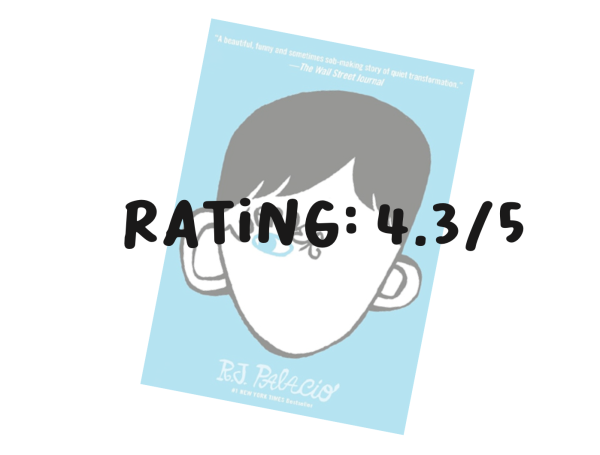
A musical adaptation of R.J. Palacio’s bestselling novel, “Wonder” follows Auggie, a middle schooler with Treacher Collins syndrome — a genetic condition that causes facial differences — as he transitions from homeschooling to public school. Told by multiple characters and through 19 musical numbers, the story focuses on Auggie’s navigation of classrooms, friendships and bullying, emphasizing the importance of empathy in how we see others.
Auggie’s imaginary friend, Moon Boy, functions as a translator of Auggie’s inner thoughts and feelings, which helps the audience understand his outlook. Moon Boy’s character is unique and effective in signaling Auggie’s initial loneliness, which sets the tone for his difficult transition to middle school. Moon Boy’s exaggerated facial expressions and blunt commentary reflect the thoughts Auggie cannot say out loud, and his presence signals when Auggie is lost in his own head. By externalizing Auggie’s thoughts and feelings, the character deepens the audience’s compassion.
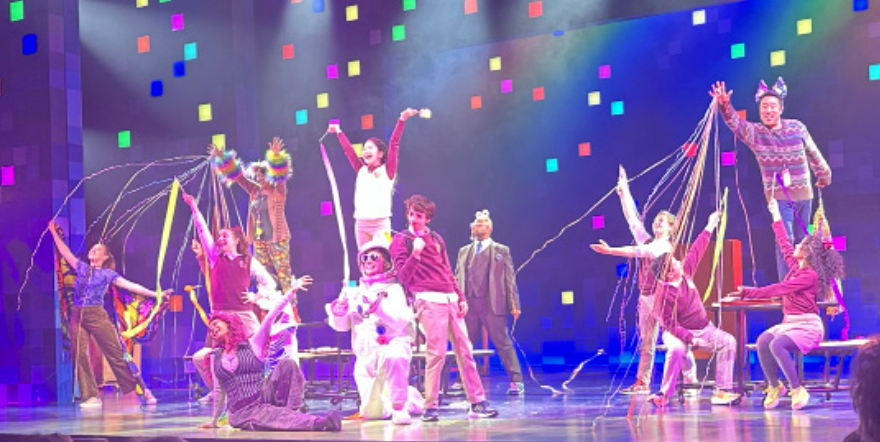
Once Auggie’s daily life is established, the musical shifts to his first day at Beecher Prep, where the staging becomes especially effective. A large turntable moves students quickly through halls and classrooms, creating a sense of rhythm and constant motion. Auggie, in contrast, is often physically still and isolated in the center of the stage. This visual choice captures his anxiety, disorientation and inability to socially keep up with the other students.
Additionally, while the teachers were very humorous and entertaining, the recurring “precepts” they brought up throughout the play seemed forced. These separate moral lessons interrupted the momentum of the main plot and pulled the audience out of the emotional storyline rather than allowing the scenes themselves to convey the themes.
One of “Wonder’s” greatest strengths is its frequent shifts in perspective. These transitions begin with a character delivering a monologue, followed by scenes and musical numbers from their point of view. Rather than serving as a simple description, these shifts reshape situations and reveal how the same events are experienced differently. This structure worked extremely well in a musical style because it gave different characters moments to stand out and it added more complex layers to the plot. By repeatedly exposing the audience to new lenses, “Wonder” reinforces its central themes of empathy and understanding.
A standout sequence is the social “war” scene, which develops Auggie’s internal panic into a full theatrical experience as the stage fills with sound and movement under red lighting. The overwhelming and chaotic environment allows the audience to feel the social tension as well as Auggie’s fear and discomfort. The scene’s commitment to an emotional atmosphere differentiates it from the more literal scenes.
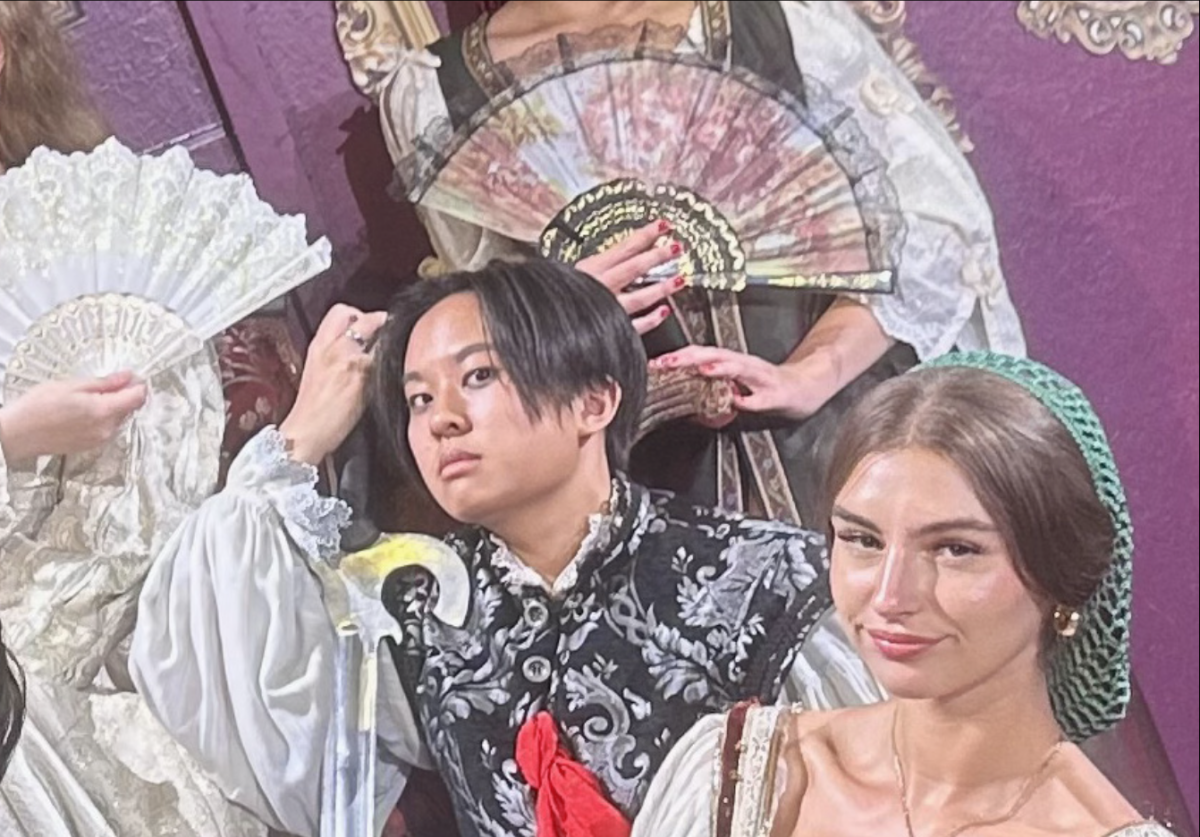
Toward the end of the musical, however, the production’s tendencies to simplify its material become more noticeable. A few narrative plot points — including Julian and Miranda’s backstories — are minimized or cut. By limiting these perspectives, the musical disrupts the balance of voices, leaving certain characters, particularly those portrayed as antagonists, underdeveloped and causing the social conflict to feel rushed and less realistic. In addition, the use of double casting, especially in the last half hour, was distracting and drew attention away from the story.
“Wonder” succeeds in expressing its central message of choosing kindness. In the final moments of the musical, the production physically engages the audience, encouraging viewers to clap along to music. As the lights spill off the stage and into the audience, “Wonder” makes its message clear: Treating others with empathy isn’t something we should just applaud but something we should embody.